How to learn AI agents has a clear verdict in 2026, which is to learn by running one ready-made agent through eight steps and to use a structured course for the theory alongside it.
These are the eight steps, in the order I'd take them.
- You understand what an agent is.
- You use one ready-made agent for a real task.
- You give it tools.
- You add memory.
- You schedule it.
- You teach it skills.
- You run several agents.
- You build your own agent OS.
I'm Julian Goldie, and I teach AI agents every day on YouTube and inside my own communities.
This page is a reference, so it rates the four ways people try to learn, lists every resource I could verify and matches each one to a step.
The Verdict: Which Way Of Learning AI Agents Works Best?
People try to learn AI agents in four different ways.
I scored each method out of ten on the things that decide whether you keep going.
These scores are my own opinion from teaching this daily, and they rate the methods and not any named course.
| Method | Speed to a working agent | Cost to start | Depth of theory | Code needed | My score |
|---|---|---|---|---|---|
| You learn by doing with one ready-made agent. | It is very fast. | It can be free. | It is light at first. | None is needed. | 9 out of 10 |
| You take a structured free course. | It is moderate. | It is free. | It is strong. | Some courses need Python. | 8 out of 10 |
| You start with a coding framework. | It is slow for beginners. | It is free. | It is very strong. | Python is required. | 6 out of 10 |
| You only watch videos. | You never get one. | It is free. | It is patchy. | None is needed. | 3 out of 10 |
My verdict is to combine the top two.
You run a real agent from day one, and you take one structured course in the background for the concepts.
The framework route is excellent for developers, and I'd save it for later if you are not one.
Watching alone scores low because nothing is ever handed to an agent.
How To Learn AI Agents Step By Step: The Reference Table
This table shows what each step teaches and what you should have at the end of it.
| Step | What you learn | What you do | Proof that you learned it |
|---|---|---|---|
| 1. What an agent is | You learn the difference between a chatbot, a workflow and an agent. | You read one good definition. | You can explain it in one sentence. |
| 2. One ready-made agent | You learn how an agent plans and acts. | You install one and finish one real task. | A real task is done. |
| 3. Tools | You learn how an agent reaches files, the web and apps. | You switch on one new tool. | The agent used fresh information. |
| 4. Memory | You learn why agents forget and how to fix it. | You set up a notes folder. | A new session already knows you. |
| 5. Scheduling | You learn how agents run without you. | You schedule one job. | A result arrived on its own. |
| 6. Skills | You learn how to make quality repeatable. | You save one correction as a skill. | You stopped repeating yourself. |
| 7. Several agents | You learn how to split work across roles. | You create a second profile. | Two agents hold two jobs. |
| 8. Your own agent OS | You learn how to manage it all from one place. | You open one dashboard. | You start your day from one screen. |
🔥 Want my exact How To Learn AI Agents setup, step by step? Inside the AI Profit Boardroom you get step-by-step video trainings, my installable Agent OS and four coaching calls a week with 3,400+ members building real automations. → Join the AI Profit Boardroom
Every Resource I Checked, With What Its Own Page Says
I checked each outside resource on the provider's own page on 13 October 2026.
I have not taken the outside courses, so the table reports what each page states and nothing more.
| Resource | Provider | Free or paid, as shown | Format | Level, as stated |
|---|---|---|---|---|
| AI Agents Course | Hugging Face | The page calls it a free course with a free certification process. | It has written units with assignments. | The page says beginner to expert. |
| AI Agents for Beginners | Microsoft | It is an open course on GitHub. | Each lesson has a written lesson, a short video and code samples. | The title says beginners. |
| Agentic AI | DeepLearning.AI | The page says you can audit it for free, and a certificate needs the Pro membership. | It is a video course taught by Andrew Ng with labs. | The page asks for intermediate Python. |
| AI Agents in LangGraph | DeepLearning.AI | The page says access is free for a limited time during its platform beta. | It is a short course taught by Harrison Chase and Rotem Weiss. | The page asks for intermediate Python. |
| MCP: Build Rich-Context AI Apps with Anthropic | DeepLearning.AI | The page says access is free for a limited time during its platform beta. | It is a short course taught by Elie Schoppik. | The page lists its own prerequisites, so check them first. |
| MCP Course | Hugging Face | The page calls it a free course built in partnership with Anthropic. | It has written units. | The page says beginner to informed. |
| Claude Academy | Anthropic | The page says free courses, tutorials and use cases. | It has courses with lessons and quizzes. | It includes fluency courses for general users. |
| LangChain Academy | LangChain | The page says course content is always free, and the certification exam is paid. | The courses are self-paced. | The page points beginners to its introduction courses. |
| Building Effective AI Agents | Anthropic | It is a free article. | It is a written engineering guide. | It suits anyone who can read a technical article. |
Here are my own resources, so you can see them next to the others.
| Resource | Free or paid | Format | Best for |
|---|---|---|---|
| Hermes FULL COURSE 2 HOURS, at the top of this page | Free | It is a YouTube video. | Steps 2 to 7 |
| How to Build Agent OS - FREE Course! | Free | It is a YouTube video. | Step 8 |
| Hermes crash course | Free | It is a written guide. | Steps 1 to 7 |
| AI Agent OS guide | Free | It is a written guide with exact prompts. | Step 8 |
| AI Money Lab | Free | It is a community with a free AI course and 1,000 AI agents. | Beginners |
| AI Profit Boardroom | Paid | It is a community with the installable Agent OS, courses and four coaching calls a week. | People who want it built and supported |
This is my own site, so weigh my own resources with that in mind.
🔥 Want one place that covers all eight steps with live help? The AI Profit Boardroom includes the installable Agent OS and courses on Hermes Agent, Grok Bot, DeepSeek Harness, Claude Opus 5.5 and Jev AI. You also get four coaching calls a week and 3,400+ members to learn with. → Get access here
Step 1 Reference: What An AI Agent Is
The clearest definition I know is in Anthropic's engineering guide.
It says workflows are systems where models and tools are orchestrated through predefined code paths.
It says agents are systems where models dynamically direct their own processes and tool usage.
The guide also recommends the simplest solution possible, and it says that might mean not building an agentic system at all.
My verdict is that this one article is enough for step one.
You should move on as soon as you can explain the idea, because reading more definitions will not make you better.
Step 2 Reference: Using One Ready-Made Agent
My pick for a first agent is Hermes Agent, which is free and open source from Nous Research.
The official docs give two install routes, which are the Hermes Desktop installer and a one-line terminal command.
The docs call hermes setup --portal the fastest path to a working agent.
Hermes does not ship one fixed model, so you choose the brain, and some models on Nous Portal are marked free.
My verdict is to use whichever agent you can get running today.
The method on this page still works if you prefer a different agent.
My best Hermes Agent setup ranking compares the ways to set it up.
Step 3 Reference: Giving An Agent Tools
Tools are functions the model can call, such as a terminal, web search and file reading.
On my own install of Hermes version 0.21.4, the tools command listed 26 built-in toolsets with 20 switched on.
MCP is the standard way to plug in outside apps.
The official MCP site calls it an open-source standard for connecting AI applications to external systems, and it compares it to a USB-C port.
People mix up three words here, so this small table settles it.
| Word | What it is |
|---|---|
| Tool | A tool is a function the model calls. |
| Plugin | A plugin is installed code that can add tools and integrations. |
| Skill | A skill is an instruction file that teaches the agent how to do one job. |
My verdict is to add one tool at a time and test each one on a real task.
Step 4 Reference: Adding Memory
Hermes has a built-in memory made of two small files and a searchable history of past sessions.
The docs limit the two files to 2,200 and 1,375 characters, which keeps them cheap to load in every prompt.
I add a plain notes vault on top, with an about-me note, a decisions log and a daily log.
My verdict is that memory is the step with the biggest payoff for the least effort.
It is also the layer that survives when you change models.
Step 5 Reference: Scheduling
A scheduled job is a prompt that runs on a timetable and delivers its result to you.
Hermes creates one with hermes cron create, and the schedule accepts cron expressions or plain forms such as every 2h.
Each run of a job that calls a model uses tokens.
My verdict is to schedule one job and live with it for a week before you add another.
Step 6 Reference: Teaching Skills
A Hermes skill is a folder with a SKILL.md file that holds the steps and pitfalls for one kind of job.
The agent loads a skill only when a task needs it, so a long skill list does not slow down every message.
You can save a correction as a skill, and the /learn command turns a guide or a book into one.
DeepLearning.AI lists a short course called Agent Skills with Anthropic if you want the idea taught formally.
My verdict is that skills are where an agent stops being a novelty and starts being reliable.
Step 7 Reference: Running Several Agents
In Hermes, separate agents are profiles, and each profile has its own memory, skills and model.
One agent can also delegate parts of a job to sub-agents, and a ticket board lets workers pick up tasks.
The delegation tool is free, but the tokens are not.
Microsoft's course includes a lesson on the multi-agent design pattern, and the DeepLearning.AI Agentic AI course covers multi-agent workflows.
My verdict is that most people reach this step too early.
One agent with good memory and three skills beats five agents with none.
Step 8 Reference: Building Your Own Agent OS
An agent OS is one dashboard, one shared memory and one task board.
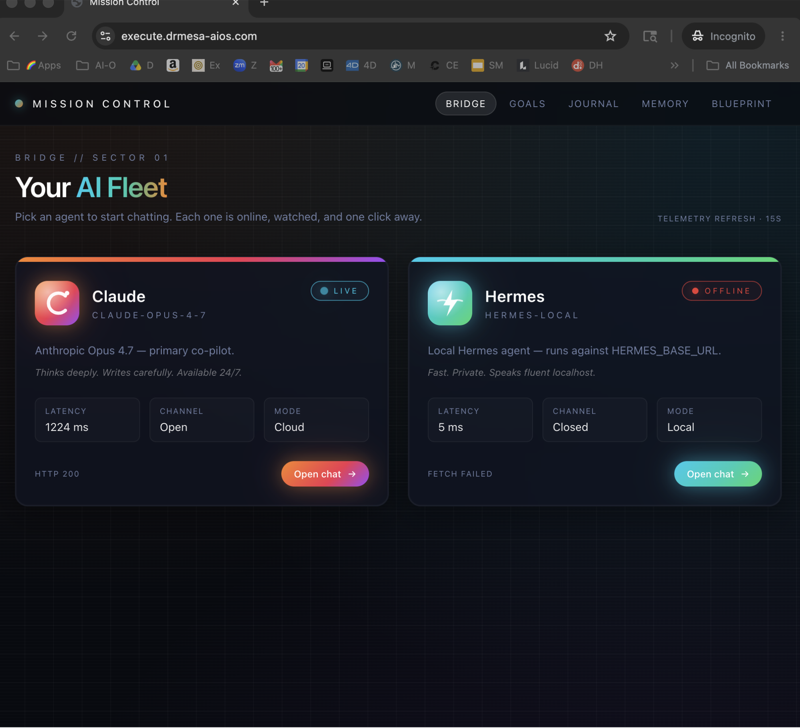
Hermes has a built-in web dashboard that you open with hermes dashboard.
My own Agent OS was built by describing what I wanted to a coding agent, reviewing it and refining it.
It has seven agents wired in.
My verdict is that you should build this last, because a dashboard for agents you do not yet use is only decoration.
A 4-Week Plan That Uses The Best Resource For Each Week
This is a plan and not a promise.
| Week | Steps | Do this | Read or watch this alongside |
|---|---|---|---|
| 1 | 1 and 2 | You install one agent and finish one real task a day. | The Anthropic article and the first part of my two-hour Hermes video |
| 2 | 3 and 4 | You add one tool and set up the notes vault. | The Hugging Face MCP Course introduction and my memory guide |
| 3 | 5 and 6 | You schedule one job and save one skill. | The Hermes docs pages on scheduled tasks and skills |
| 4 | 7 and 8 | You add a second profile and open a dashboard. | My free Agent OS video course |
If you want theory running in the background, the Hugging Face AI Agents Course fits well next to this plan.
How Long Does It Take, According To The Sources?
It depends, and I will only quote timings I can point to.
| Source | What it says |
|---|---|
| Hugging Face AI Agents Course | Each chapter is designed for one week, at approximately three to four hours of work a week. |
| Anthropic Claude Academy | Courses are listed with lengths such as 45 minutes, 3.5 hours and 4 hours. |
| My memory guide | The notes vault takes about an afternoon to do properly. |
| Hermes docs | The install is a single command. |
None of those tell you when you will be good.
That depends on how many real jobs you hand over, and I cannot measure that for you.
The Mistakes I'd Avoid
- You should not start with the multi-agent step because it looks impressive.
- You should not add many tools before one of them is useful.
- You should not save everything to memory.
- You should not run hard work on a weak model and judge agents by the result.
- You should not schedule every idea.
- You should not trust sub-agent output without checking it.
- You should not collect courses in place of finishing jobs.
🔥 Ready to go further than the free path? The AI Profit Boardroom is my paid community, with the Agent OS ready to install, tutorials for every step and four coaching calls a week. It has 3,400+ members. → Join the AI Profit Boardroom
Related Reading
- The best AI agent course is my ranked list if you want one course to follow.
- How to learn AI agents for free covers the zero-cost route in detail.
- How to learn AI agents from scratch is written for complete beginners.
- My best Skool courses list compares learning communities.
Also On Our Network
- 🌐 The operator walkthrough for learning AI agents, with commands
- 🌐 A business owner's plan for learning AI agents
- 🌐 Learn AI agents by building your own Agent OS
- 🌐 Which model should you learn AI agents on? Live scores
FAQ: How To Learn AI Agents
What is the best way to learn AI agents in 2026?
My verdict is to learn by doing with one ready-made agent, following eight steps in order.
I'd take one structured course alongside for the theory.
Which free course is best for learning AI agents?
It depends on your goal.
The Hugging Face AI Agents Course says it is free and runs from beginner to expert.
Microsoft's AI Agents for Beginners is a free course on GitHub.
Should I learn a framework like LangGraph first?
I would not start there unless you already write Python.
A ready-made agent teaches you what agents are good at much faster.
How long does it take to learn AI agents?
It depends on your hours and your goal.
Hugging Face says each chapter of its course is designed for one week at about three to four hours a week.
Are paid AI agent courses worth it?
Paid options are worth it when you need live help, a community or a system that is already built.
Everything you need to start is available free, so I'd start free.
Do I need Python to learn AI agents?
You do not need Python to run and manage agents with a ready-made tool.
You do need it for framework courses.
📺 Video notes + links to the tools 👉
🎥 Learn how I make these videos 👉
🆓 Get a FREE AI Course + Community + 1,000 AI Agents 👉
About Julian
I'm Julian Goldie, an SEO entrepreneur, author and founder of the AI Profit Boardroom, which has 3,400+ members.
I help business owners scale with AI agents, automation and SEO.
- I started Goldie Agency on my own, and it is now a 7-figure SEO and link-building agency with 70+ people.
- I've grown my YouTube channel to 400,000+ subscribers.
- I wrote "Link Building Mastery".
- My Udemy courses have taught 29,000+ students.
→ Get my best AI training inside the AI Profit Boardroom
Run one real agent, follow the eight steps in order, and add one course for the theory, because that is my honest verdict on how to learn AI agents.