How to learn more about AI agents after the basics has a short answer, which is to watch a daily build video, join one community and read the release notes of the agent you actually use.
I'm Julian Goldie, and I've ranked nine kinds of learning source on this page so you can choose quickly.
This is a reference page, so every source gets the same treatment.
You'll see what it is, who it suits, what it costs, how much time it needs and what to watch out for.
After the ranking, I give you a daily stack, a launch-day test and a checklist for spotting hype.
Top 3 Ways To Learn More About AI Agents At A Glance
- 🥇 Daily build videos are my first pick, and my YouTube channel publishes AI tutorials daily for 400,000+ subscribers.
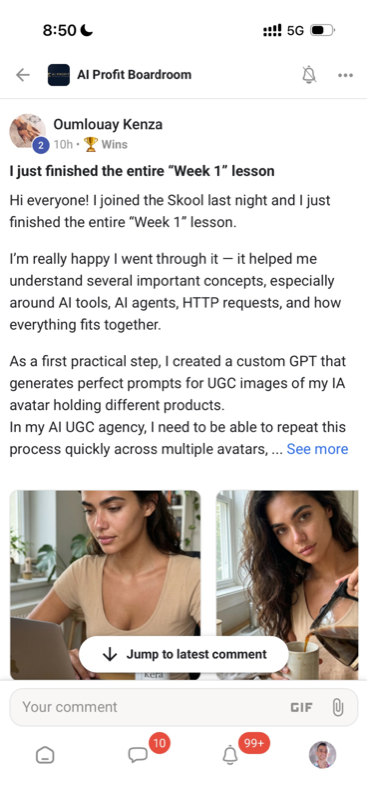
- 🥈 A community is my second pick, and that means the AI Profit Boardroom if you want coaching or the free AI Money Lab if you want to start at no cost.
- 🥉 Written guides are my third pick, and agentos.guide is where I publish mine for free.
This is my own list on my own site, so my own channels lead it, and you should weigh it with that in mind.
The third-party sources further down are listed neutrally, with only facts I could check on their own pages on 13 October 2026.
How I Ranked These Sources
I used four criteria, and I scored each source out of five on them.
- Speed measures how soon after a launch the source helps you.
- Depth measures how much real detail you get.
- Action measures how easily the source turns into something you build.
- Effort measures how little time it takes, so a higher score means less effort.
The scores are my own judgement and not a measurement.
I ranked by format, because the right format matters more than the specific name.
The 9 Ways To Learn More About AI Agents, Ranked
1. Daily Videos
A build video shows you a tool running on a real screen, with the mistakes left in.
I publish daily AI and SEO tutorials on my YouTube channel, and I run a second channel called AI News Today for podcast-style AI news.
Best for: seeing whether a new tool is worth installing.
Cost: free.
Time: you need about thirty minutes for one video with pauses to copy the steps.
Watch out for: watching five videos in a row and building nothing.
2. Communities
A community is where you ask the question a video didn't answer.
The AI Profit Boardroom is my main one, with 3,400+ members, the installable Agent OS, courses on Hermes Agent, Grok Bot and DeepSeek Harness, and four coaching calls a week.
The AI Money Lab is my free one, with a free AI course and 1,000 AI agents.
Best for: getting unstuck and seeing what other people are building.
Cost: the AI Profit Boardroom is paid, and the AI Money Lab is free.
Time: you need one post and one call a week.
Watch out for: reading every thread instead of posting your own build.
3. Written Guides
A written guide lets you move at your own speed and copy exact prompts.
On agentos.guide I publish free guides and full courses, such as the Hermes crash course, the DeepSeek Harness course and the Grok Bot course.
Best for: following a build from start to finish.
Cost: free.
Time: you need one or two thirty-minute sittings per guide.
Watch out for: skipping the steps and reading it like a news article.
🔥 Want the top three in one place? Inside the AI Profit Boardroom, you get the video tutorials, the written setups and the community together, plus the installable Agent OS and four coaching calls a week. There are 3,400+ members inside. → Get access here
4. A Model Leaderboard
A leaderboard tells you which model to try next without reading every launch post.
GoldieBench is mine, and every model on it gets the same fixed prompts with one shot each and a score from 0 to 10.
Best for: following new models and choosing a brain for your agent.
Cost: free.
Time: you need five minutes when a new model lands.
Watch out for: treating any leaderboard as the final word, because it measures its own tasks and not yours.
5. Official Docs And Changelogs
Docs and changelogs are written by the people who built the tool, so they are the most accurate source on this page.
| Source | What it offers |
|---|---|
| Hermes Agent docs | The docs include a Learning Path with beginner, intermediate and advanced reading orders. |
| Hermes Agent releases | The page listed four releases between 21 September and 12 October 2026. |
| Claude release notes | Anthropic records changes to the Claude platform here. |
| Anthropic Academy | Anthropic lists courses including Claude Code 101, Building with the Claude API and Introduction to Model Context Protocol. |
| OpenAI API changelog | OpenAI records API changes here. |
| OpenAI Agents SDK docs | OpenAI documents its framework for multi-agent workflows here. |
| Google Agent Development Kit docs | Google documents its open-source agent toolkit here. |
| Model Context Protocol | This is the home of the standard for connecting agents to tools. |
Best for: knowing exactly what a feature does.
Cost: free.
Time: you need five minutes a week for release notes and thirty minutes for a docs page.
Watch out for: reading docs for tools you don't use.
6. GitHub Repos
A repo shows you whether a project is alive, because the last update is on the page.
| Repo | What it is |
|---|---|
| NousResearch/hermes-agent | This is the Hermes Agent source. |
| anthropics/claude-code | This is Anthropic's agentic coding tool for the terminal. |
| openai/codex | This is OpenAI's terminal coding agent. |
| openai/openai-agents-python | This is OpenAI's framework for multi-agent workflows. |
| google/adk-python | This is Google's Python toolkit for building agents. |
| modelcontextprotocol/servers | This repo holds Model Context Protocol servers. |
| langchain-ai/langgraph | This is LangGraph, an agent framework. |
| microsoft/ai-agents-for-beginners | This is Microsoft's 18-lesson course on building agents. |
| huggingface/agents-course | This is the repo for the Hugging Face Agents Course. |
Every repo above had commits in October 2026 when I checked.
Best for: release alerts and reality checks.
Cost: free.
Time: you need almost none if you set Watch to Releases only.
Watch out for: judging a project by its star count instead of its recent activity.
7. Newsletters And Blogs
A newsletter gives you one summary a week with some context around it.
| Source | What it is |
|---|---|
| Simon Willison's Weblog | This is a personal blog on AI tools that is updated often. |
| Latent Space | This is a technical newsletter and podcast for AI engineers. |
| Import AI | This is Jack Clark's weekly newsletter. |
| The Batch | This is DeepLearning.AI's weekly AI news email. |
| Hugging Face blog | This is Hugging Face's blog on open models and tools. |
Each one had published within the week before I checked.
Best for: a wide view in ten minutes.
Cost: free to read.
Time: you need ten minutes a week.
Watch out for: subscribing to five and reading none.
8. X Accounts
X is the fastest source and the noisiest one.
I'd follow official accounts that are linked from each organisation's own website, such as @NousResearch, @AnthropicAI and @GoogleDeepMind.
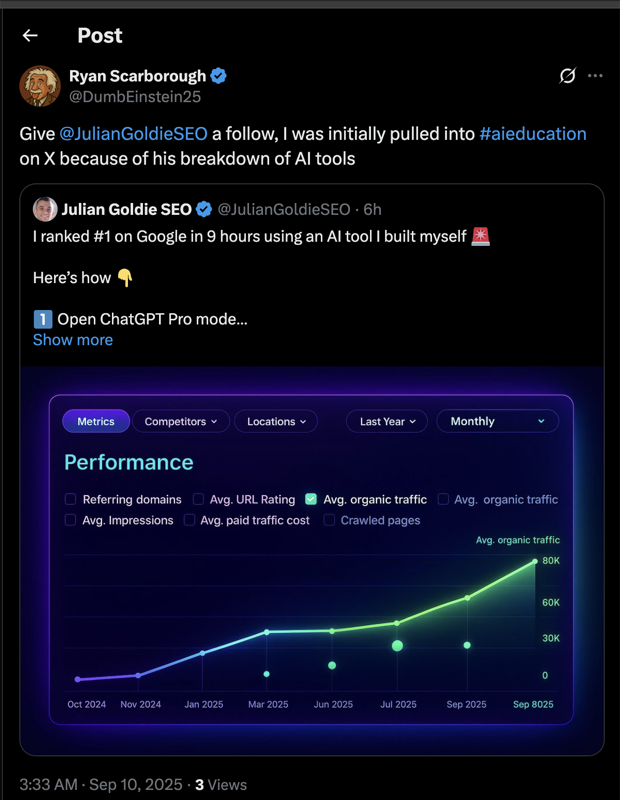
@simonw belongs to Simon Willison, and @JulianGoldieSEO is mine.
Best for: knowing that something launched today.
Cost: free.
Time: you need five minutes a day at most.
Watch out for: believing a claim before you've opened the docs.
9. Research Papers
Papers explain why agents behave the way they do.
| Paper | Year | The idea |
|---|---|---|
| ReAct | 2022 | The model reasons and then acts in a loop. |
| Toolformer | 2023 | The model learns to call tools. |
| Generative Agents | 2023 | The agents use memory, reflection and planning. |
| Attention Is All You Need | 2017 | The paper introduced the transformer. |
Best for: people who enjoy the theory.
Cost: free on arXiv.
Time: you need an hour or more per paper.
Watch out for: feeling productive while nothing gets built.
🚀 Ready to put How To Learn More About AI Agents to work in your business? Inside the AI Profit Boardroom you get step-by-step video trainings, my installable Agent OS and four coaching calls a week with 3,400+ members building real automations. → Join the AI Profit Boardroom
The 9 Sources Compared At A Glance
| Rank | Source | Speed | Depth | Action | Effort | Total out of 20 |
|---|---|---|---|---|---|---|
| 1 | Daily videos | 5 | 4 | 5 | 4 | 18 |
| 2 | Communities | 4 | 4 | 5 | 4 | 17 |
| 3 | Written guides | 4 | 5 | 5 | 3 | 17 |
| 4 | Model leaderboard | 4 | 3 | 4 | 5 | 16 |
| 5 | Docs and changelogs | 4 | 5 | 4 | 3 | 16 |
| 6 | GitHub repos | 5 | 3 | 3 | 4 | 15 |
| 7 | Newsletters and blogs | 3 | 4 | 2 | 4 | 13 |
| 8 | X accounts | 5 | 1 | 2 | 3 | 11 |
| 9 | Papers | 1 | 5 | 1 | 1 | 8 |
Communities sit above written guides on a tie because feedback from people is the thing a guide can't give you.
Docs score lower on effort only because they take longer to read, and they are still the source I'd trust most on facts.
The 30-Minutes-A-Day Stack
You don't need all nine sources.
Here are three stacks, and each one fits into thirty minutes a day.
| Stack | What is in it | Who it suits |
|---|---|---|
| Minimal | You follow one video channel, one community and one changelog. | It suits busy owners. |
| Standard | You add a leaderboard, two watched repos and one newsletter. | It suits people who build every week. |
| Deep | You add docs deep-dives and one paper a month. | It suits people who teach or build for clients. |
A simple week on the standard stack looks like this.
- On Monday you read your main tool's release notes.
- On Tuesday you watch one build video and copy it.
- On Wednesday you build with one new feature.
- On Thursday you read one docs page.
- On Friday you test one new tool or model.
- On Saturday you post your build in a community.
- On Sunday you review your notes and choose next week's build.
How To Test A New Tool The Day It Launches
The best way to judge a launch is to run it.
My routine is published on my GoldieBench about page.
- I wire the new model into my Agent OS.
- I run my fixed prompt set through it, with one shot each and no hints.
- I score each result from 0 to 10 on camera, based on whether it ran, how close it got to the brief and how good it looks.
Your version needs three to five prompts saved in a file and a sheet for the scores.
The prompts never change, because that is what makes two tools comparable.
The Hype Checklist
You give a tool or a claim one point for each line it passes.
| Check | What a pass looks like |
|---|---|
| Is there a repo or official docs? | You can open it and see install steps in the README. |
| Is it active? | You can see updates from the last few weeks. |
| Is the claim dated? | You know when it was written and which version it describes. |
| Can you run it today? | You can install it or open it without a waitlist. |
| Did it pass your own prompts? | It matched or beat your current tool on your fixed set. |
The date check deserves an example.
Anthropic's engineering post, Building effective agents, was published on 19 December 2024, and it now carries a note saying much of the tooling it describes has changed.
The last check deserves one too.
On GoldieBench, Claude Opus 5 averages 8.27 and the newer Claude Opus 5.5 averages 7.57 on the same prompts. Opus 5.5 was scored in a separate, stricter run than Opus 5, so I treat that gap as a reason to test, not as proof.
Newer is not automatically better for a given task, so you test before you switch.
🔥 Want my test results and setups without running every launch yourself? Inside the AI Profit Boardroom, I share the setups from my daily videos, and you can ask about any tool on four coaching calls a week. You also get the Agent OS that every new model gets wired into, with 3,400+ members alongside you. → Get access here
How To Turn Learning Into A Build
A source only earns its place if it leads to a build.
I teach the same order every time.
- You start with one agent doing one job.
- You keep one profile per model.
- You use free models first.
- You connect the jobs into an Agent OS once a few of them work.
One lesson should become one small build within 48 hours.
My Agent OS build guide shows the full dashboard in five steps if you want the bigger project.
The Verdict On How To Learn More About AI Agents
My verdict is that format beats volume.
One video a day, one community and one changelog will teach you more than thirty feeds.
You add the leaderboard, repos and a newsletter when you are building every week.
You leave papers for the weeks when you're curious.
You test everything yourself, because that is the only source that knows your work.
Related Reading
- My how to learn AI agents guide covers the path from the start.
- My best AI agent courses online ranking compares structured courses.
- My best AI agent course for 2026 gives my single pick for this year.
- My best Skool courses list ranks communities.
- My Julian Goldie page explains who is behind this ranking.
Also On Our Network
- 🌐 The weekly operator routine for learning more about AI agents
- 🌐 How business owners turn AI agent learning into real builds
- 🌐 The Agent OS learning loop, step by step
- 🌐 How to follow new AI models with real one-shot scores
FAQ: How To Learn More About AI Agents
What is the best way to learn more about AI agents?
My top three are daily build videos, a community where you can ask questions and written step-by-step guides.
Official docs and changelogs are the most accurate source for what a tool really does.
Which sources are free?
Almost all of them are free.
My YouTube and podcast channels, the AI Money Lab, agentos.guide, goldiebench.com, official docs, GitHub repos, the newsletters listed and arXiv papers cost nothing, and the AI Profit Boardroom is paid.
Which official docs should I read for AI agents?
You read the docs for the tool you use.
Well-known ones include the Hermes Agent docs, the Claude release notes and Anthropic Academy, the OpenAI API changelog and Agents SDK docs, Google's Agent Development Kit docs and the Model Context Protocol site.
Which research papers on AI agents are worth reading?
Three well-known ones are ReAct from 2022, Toolformer from 2023 and Generative Agents from 2023.
Attention Is All You Need from 2017 introduced the transformer that today's models are built on.
How do I check whether an AI agent tool is hype?
You check that it has a repo or official docs with recent activity.
You check the date of the claim, and you run the tool on your own fixed prompts before you believe a comparison.
How many sources should I follow?
Three is enough for most people, which means one video source, one community and one changelog.
Adding more sources usually adds reading time without adding builds.
📺 Video notes + links to the tools 👉
🎥 Learn how I make these videos 👉
🆓 Get a FREE AI Course + Community + 1,000 AI Agents 👉
About Julian
I'm Julian Goldie, an SEO entrepreneur, author and founder of the AI Profit Boardroom, which has 3,400+ members.
I help business owners scale with AI agents, automation and SEO.
- I started Goldie Agency on my own, and it is now a 7-figure SEO and link-building agency with 70+ people.
- I've grown my YouTube channel to 400,000+ subscribers.
- I wrote "Link Building Mastery".
- My Udemy courses have taught 29,000+ students.
→ Get my best AI training inside the AI Profit Boardroom
Choose your three sources today, run one test on Friday, and you'll have a working answer to how to learn more about AI agents.