My verdict on how to do GEO for website owners is that nine steps do the real work, and the most important three are a Search Console export, case-study pages and a human fact-check.
GEO means generative engine optimisation, which is the work of getting your business named when someone asks Google AI, Gemini or ChatGPT a question.
I've rated every step below for impact and effort, based on the workflow I run on my own sites and show in my Hermes Agent GEO video.
The scores are my own opinion from my own testing, not an industry standard, so use them as a guide to where your time goes first.
If you'd rather have my team rate your site directly, book a free one-to-one GEO, AEO AI audit and get a custom game plan.
How To Do GEO For A Website: The 9 Steps Scored
This is the full method with my impact and effort scores, so the steps are on screen before any detail.
| Step | What you do | Impact (my score /10) | Effort | My verdict |
|---|---|---|---|---|
| 1 | Log who the AI answers name for your buyer questions. | 7 | Low | Do it first, because without it you can't prove anything changed. |
| 2 | Export your Search Console performance data to CSV. | 8 | Low | It's free and fast, and it feeds every later step. |
| 3 | Ask an agent like Hermes to find your GEO topics from the CSV. | 8 | Low | It's the biggest time saver in the whole workflow. |
| 4 | Write case-study-led pages with an SEO skill. | 10 | High | It's the step that actually gets you named. |
| 5 | Publish different angles across several sites and platforms. | 9 | High | It's powerful, but only if every version is genuinely useful. |
| 6 | Publish on new topics within 24 hours. | 8 | Medium | It's the cheapest win when your niche moves fast. |
| 7 | Check crawler access and basic schema. | 6 | Low | It's a one-off check that stops silent failures. |
| 8 | Fact-check every line by hand, then publish. | 9 | Medium | It's non-negotiable under Google's 1 October 2026 guidance. |
| 9 | Measure clicks and AI impressions, then repeat. | 7 | Low | It's what turns one page into a system. |
If you only have one afternoon, do steps two, three and seven.
If you have a month, step four is where the time should go.
🔥 Want my exact How To Do GEO For A Website setup, step by step? Inside the AI Profit Boardroom you get step-by-step video trainings, my installable Agent OS and four coaching calls a week with 3,400+ members building real automations. → Join the AI Profit Boardroom
What GEO Is, In One Reference Section
GEO is short for generative engine optimisation.
The term comes from a 2023 research paper on arXiv called GEO: Generative Engine Optimization by Pranjal Aggarwal and co-authors, which was accepted to KDD 2024.
In practice, it means making your business the name an AI answer gives.
Old SEO gave ten blue links, and position seven still got some clicks.
AI answers usually give a short list of maybe one to three names, so there's no room for number seven.
The AI reads the pages that rank and sums up what they say, which I compare to five friends recommending the same restaurant.
Google's own guide to optimising for generative AI features says that, from Google's point of view, optimising for generative AI search is still SEO.
I agree with that, which is why every step below starts from normal SEO foundations.
The Evidence Behind My Scores
My scores come from what I show on screen in my video.
- For "best geo expert", my content appeared in the Google AI answer at the top and in the first organic spot, and in AI Mode too.
- For "best AI community", my community ranked first inside Google AI and was listed twice.
- When I asked AI Mode for the best GEO experts to follow in 2026, it listed me first and linked to my sites.
- Perplexity also listed me among GEO experts, although I don't really use Perplexity.
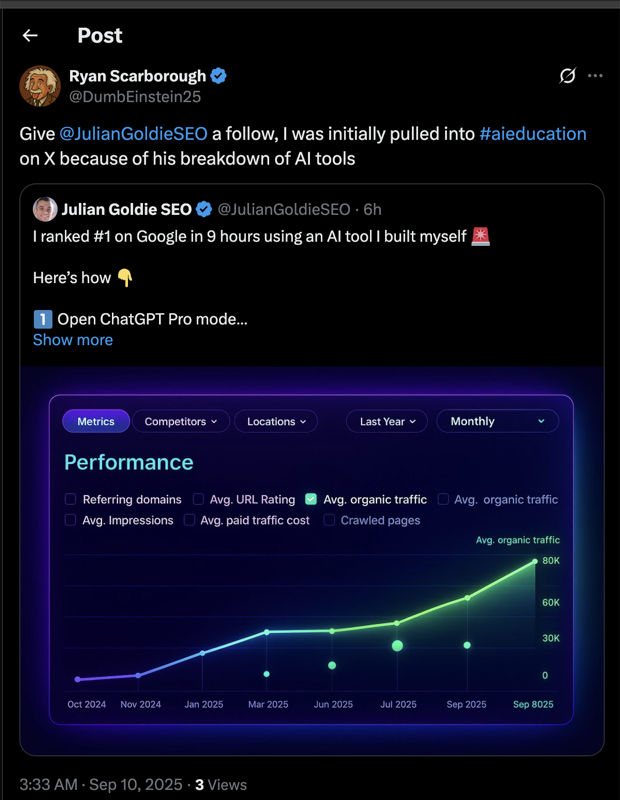
- One of my sites went from zero to more than 1,300 clicks a day, and two other sites are on the same trajectory.
These are my own results, so they show the method can work, not that it will work the same way for you.
Step 1 Reviewed: The AI Visibility Baseline
The baseline means asking your real buyer questions in Google AI Mode, AI Overviews, ChatGPT and Gemini, then logging who gets named.
I score it 7 for impact, because it doesn't change anything on its own but it makes every later result measurable.
Effort is low, because ten to twenty questions take about an hour.
My verdict is that you should never skip it, and my AEO audit checklist goes deeper if you want a full scorecard.
Step 2 Reviewed: The Search Console CSV Export
This is the first step of my Hermes workflow.
Search Console is what Google calls a free service, and its Performance report has an export button for the chart and table data.
I score it 8, because it shows you what Google already trusts you for, and AI answers lean on the pages that already rank.
The one weakness is that it's Google organic data, and Google and the AI engines still don't report AI traffic in much detail.
My verdict is that it's the best free starting dataset you have.
Step 3 Reviewed: Letting Hermes Find The GEO Topics
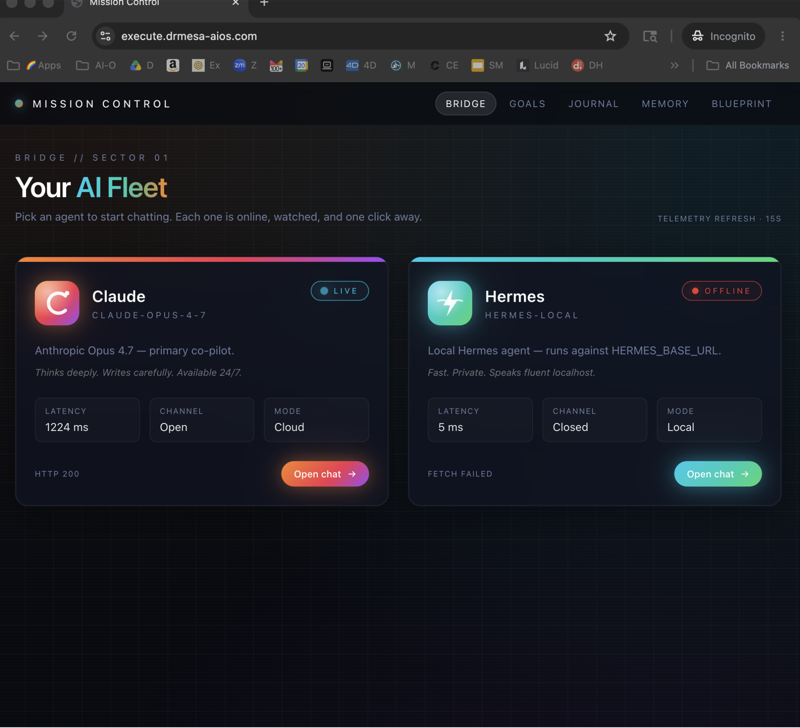
I give the CSV to Hermes Agent, an open-source agent from Nous Research under the MIT licence.
For the brain I use OpenCode, which says it includes free models, and DeepSeek V4.1 Flash was free in it when I recorded.
My prompt is close to "can you analyse this and, based on what's actually working, give me keyword and topic ideas to rank inside AI search engines?"
Hermes built a report artifact with total clicks, the brand share of clicks, non-brand click-through rate and my September clicks.
It listed what was working, such as comparison articles, my Agent OS clusters, the free AI community topic and my Antigravity and Hermes topics, then gave a verdict on my best pages.
I score it 8 for impact, because the report turns a spreadsheet into a decision in minutes.
My verdict is that it's the best effort-to-value step in the list, as long as you sanity-check the report against your own knowledge.
📞 Want a strategist to read your Search Console data with you? Book a free AEO SEO strategy session and my team will look at your site, your competitors and the keywords you're closest to winning. → Get your custom game plan for Google and AI search
Step 4 Reviewed: Case-Study Pages With An SEO Skill
I give Hermes my SEO skill and access to my sites, such as WordPress and Netlify, so it can write and publish.
The skill is roughly a 100-point checklist that writes everything from a case-study angle.
My demo prompt asks it to "create an SEO article using your SEO skill and the keyword 'GEO examples' and publish to aiprofitboardroom.com".
I score this step 10, because it's the one that gets you named.
AI Mode describes me as widely recognised as a top practitioner because of public testing and deployment, so the proof of use is what earns the mention.
Google's guide points the same way, because it favours first-hand, non-commodity content over summaries of what others have said.
Effort is high, because real case studies need real work behind them.
My verdict is that this is where most of your time should go, whether you write in Hermes or inside Claude.
Here is my Claude AI SEO video, which shows the Claude side of the same idea.
🚀 Ready to put How To Do GEO For A Website to work in your business? Inside the AI Profit Boardroom you get step-by-step video trainings, my installable Agent OS and four coaching calls a week with 3,400+ members building real automations. → Join the AI Profit Boardroom
Step 5 Reviewed: Being Everywhere
I run multiple websites, each with a different angle, all pointing to the same answer.
That's how I can show up two to four times on page one for one search, and my subreddit, AI SEO Insider, ranks on page one too.
I score it 9 for impact, because several good pages agreeing on you is exactly what the AI summarises.
The risk is real, though, because Google's guide says making separate pages for every search variation, mainly to manipulate rankings or AI answers, breaks its scaled content abuse policy.
My verdict is that it's excellent with genuinely different, useful angles and harmful with copies.
Step 6 Reviewed: Being First
I try to publish within 24 hours of a topic appearing.
When Jev AI dropped, I covered "Jev architecture" and "Jev waitlist" that same weekend.
I score it 8, because the first good answer is often the only one the AI can find.
Effort is medium, because you need someone or something watching your niche every day.
My verdict is that an agent watching launches is worth setting up if your market changes often.
Step 7 Reviewed: Crawler Access And Schema
Google says there are no additional requirements to appear in AI Overviews or AI Mode, as long as the page is indexed and eligible for a snippet.
The checks are your robots.txt for Googlebot, OAI-SearchBot per OpenAI's bots page, PerplexityBot per Perplexity's bots guide, and the Search Console Search generative AI control, which includes your site by default.
Google's guide says no special schema is needed for its AI features, but structured data still helps with rich results, so I run key pages through the Rich Results Test.
I score it 6, because it rarely wins you anything but a mistake here can quietly hide you.
My verdict is to check it once, then again after any site migration.
Step 8 Reviewed: The Human Fact-Check
Google updated its page on using generative AI content on 1 October 2026.
It says it's "critical to manually factcheck and review all AI-generated content" before publishing, and that covers titles, descriptions, structured data and alt text.
It also explains that generative models predict likely words rather than retrieving facts, which is why errors slip in.
I score it 9, because one confident wrong claim can damage the trust the whole method depends on.
My verdict is that the agent can draft and even push, but a human signs off every page first.
Step 9 Reviewed: Measuring And Repeating
Re-run your step one questions every couple of weeks and compare.
Google's guide points to the Generative AI performance report in Search Console, which shows AI feature impressions, has an export button and rolled out to all sites as of 31 August 2026.
AI Mode does send traffic, and I show that on screen.
I score it 7, because measurement is what tells you which topic deserves the next case study.
My verdict is that the new export goes straight back into step three, which is what makes the workflow a loop.
GEO Advice I'd Skip
Google's guide has a mythbusting section, and I agree with most of it.
- An llms.txt file won't help in Google, because the guide says Google Search ignores it.
- Chopping content into tiny chunks for AI isn't required, according to the same guide.
- Rewriting pages in a special style just for AI isn't necessary either.
- Chasing inauthentic mentions isn't as helpful as it might seem, in Google's own words.
- Any tool that claims to use internal Google metrics should worry you, because Google says no third-party tool has that access.
- Anyone who guarantees an AI placement is overselling, because nobody can promise what an AI answer will say.
Final Verdict On The Steps
The steps that matter most are four, five and eight, because they create the proof, spread it and keep it accurate.
The steps that save the most time are two and three, because the Search Console export plus Hermes replaces hours of guesswork.
The weakest step on its own is seven, but it's a cheap insurance policy.
If you want help, the free AEO SEO strategy session is a call rather than a written report, where my team looks at your site, your competitors and the keywords you're closest to winning.
Inside the AI Profit Boardroom you get my Agent OS, the SEO skill and checklist, an AI SEO automation section, four coaching calls a week and a member map with 3,400+ members.
📞 Want your own site scored against these nine steps? Claim a free strategy session and leave with a plan to rank in Google and AI search. → Book the free call
Related Reading On This Site
- Read my verdict on four real GEO examples.
- See ten free GEO audit checks rated by evidence.
- Find out whether Hermes Agent for SEO is worth it.
- Compare the GEO agencies I rate if you'd rather hire help.
Also On Our Network
- 🌐 The full operator walkthrough with every prompt
- 🌐 How a local business, consultant or agency runs each step
- 🌐 A quick-start version for your Agent OS
- 🌐 How the models behind a GEO agent score
FAQ: How To Do GEO For A Website, Rated
Which GEO step matters most?
In my scoring, writing case-study-led pages matters most.
That's the step that gives the AI something real to cite, and it's what gets you named as the expert.
Which GEO step can I skip?
I wouldn't skip any of the nine, but llms.txt files and chunked content are hacks I'd skip.
Google's guide says Google Search ignores llms.txt and doesn't need content chopped into tiny pieces.
Are these GEO scores official?
No, they're my own opinion based on my own sites and testing.
Use them to decide where your time goes first, not as an industry standard.
Does GEO replace SEO?
No, and Google's guide says optimising for generative AI search is still SEO from its point of view.
The AI reads the pages that rank, so normal SEO is the foundation for every GEO step.
Can I do all nine GEO steps for free?
Yes, the tools in my workflow are free, because Search Console is a free service, Hermes Agent is open source and OpenCode includes free models.
Which models are free can change, so check on the day you set it up.
Is the free strategy session a written GEO report?
No, it's a free one-to-one call rather than a written report.
My team looks at your site, your competitors and the keywords you're closest to winning, then gives you a custom game plan for Google and AI search.
📺 Video notes + links to the tools 👉
🎥 Learn how I make these videos 👉
🆓 Get a FREE AI Course + Community + 1,000 AI Agents 👉
About Julian
I'm Julian Goldie, an SEO entrepreneur, author and founder of the AI Profit Boardroom, which has 3,400+ members.
I help business owners scale with AI agents, automation and SEO.
- I started Goldie Agency on my own, and it is now a 7-figure SEO and link-building agency with 70+ people.
- I've grown my YouTube channel to 400,000+ subscribers.
- I wrote "Link Building Mastery".
- My Udemy courses have taught 29,000+ students.
→ Get my best AI training inside the AI Profit Boardroom
Start with the high-impact, low-effort steps, book a free strategy session if you want your site scored, and you'll have a tested answer to how to do GEO for website growth.